
Keywords
How to Cite
Abstract
Diabetes mellitus encompasses a group of metabolic disorders characterized by the presence of elevated blood glucose. Its vascular complications generate a decrease in blood flow in the lower extremities, that together with the neuropathic affectation gives place to the diabetic foot with ulcers difficult to heal.
Knowledge of the underlying disease (diabetes) is crucial for the prevention and treatment of diabetic foot complications.
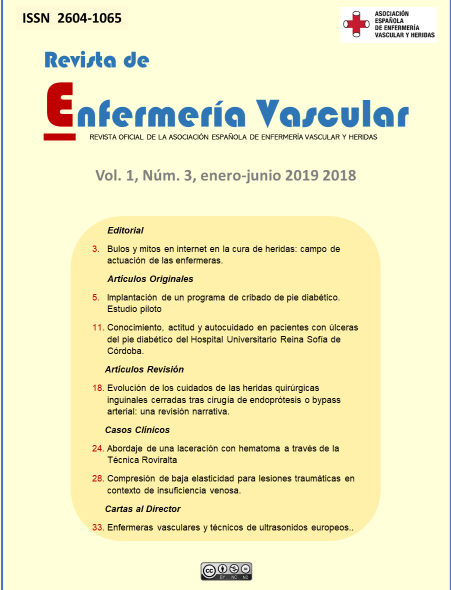
The objective of the study was to know the degree of knowledge that diabetic patients have about the care of their feet and their complications, their willingness to change their habits to improve their quality of life and, finally, the measures that have been adopted in practice to prevent the appearance of ulcers. A descriptive study was conducted in diabetic patients with ulcers treated in the Diabetic Foot and Vascular Ulcer Unit of the Hospital University Reina Sofía de Córdoba.
The importance of the knowledge of foot care to prevent ulcers in diabetic patients is a widely accepted fact, although there may be other variables that affect the appearance of complications. The result of the study shows that more than two thirds of the diabetic patients studied have an intermediate / high knowledge about the implications of their disease in the development of foot complications. Deficiencies in the knowledge and self-care of the feet in the patients studied have been highlighted and the need to establish an effective educational program to reduce diabetic foot complications.
References
Armstrong DG, Boulton AJ, Bus SA. Diabetic foot ulcersand their recurrence. N Engl J Med. 2017; 376:2367-75.
Bazata DD, Robinson JG, Fox KM, Grandy S, SHIELD Study Group. Affecting behavior change in individuals with diabetes: findings from the study to help improve early evaluation and management of risk factors leading to diabetes (SHIELD). The Diabetes Educator 2008;34:1025–36.
Beck J, Greenwood DA, Blanton L. 2017 National Standards for Diabetes Self-Management Education and Support.The Diabetes EDUCATOR.2018; 44 (1):35-50.
Bus SA, van Netten JJ. A shift in priority in diabetic foot care and research: 75% of foot ulcers are preventable. Diabetes Metab Res Rev.2016; 32(1):195-200.
Bus SA, Van Netten JJ, Lavery LA, et al. IWGDF Guidance on the prevention of foot ulcers in at-risk patients with diabetes. Diabetes Metab Res Rev. 2016 Jan; 32Suppl 1:16-24.
Chellan G, Srikumar S, Varma AK, Mangalanandan TS, Sundaram KR, Jayakumar RV, et al. Foot care practice – The key to prevent diabetic foot ulcers in India. The Foot.2012; 22: 298– 302.
Chiwanga, FC, Njelekela, M.A. Diabetic Foot: Prevalence, Knowledge, and Foot Self-Care Practices among Diabetic Patients in Dar es Salaam, Tanzania—A Cross-Sectional Study. Journal of Foot and Ankle Research.2015; 8:20.https://doi.org/10.1186/s13047-015-0080-y.
Hasnain S, Sheikh NH. Knowledge and practices regarding foot care in diabetic patients visiting diabetic clinic in Jinnah Hospital, Lahore. J Pak Med Assoc. 2009; 59(10):687-90.
Khamseh ME, Vatankhah N, Baradaran HR. Knowledge and practice of foot care in iranian people with type 2 diabetes .Int Wound J. 2007;4(4):298-302.
Margolis DJ, Hoffstad O, Nafash J, Leonard CE, Freeman CP, Hennessy S, et al. Location, location, location: geographic clustering of lower-extremity amputation among Medicare beneficiaries with diabetes. Diabetes Care. 2011; 34(11):2363-7.
Ministerio de Sanidad, Servicios Sociales e Igualdad. Guia de práctica clínica sobre diabetes mellitus tipo I. Vitoria-Gasteiz: SNS; 2012.
Morbach S, Icks A, Rümenapf G, Armstrong DG. Comment on: Bernstein reducing foot wounds in diabetes. Diabetes Care. 2013 Apr; 36(4):e62.
Paisey R, Abbott A, Levenson A, et al. Diabetesrelated major lower limb amputation incidence is strongly related to diabetic foot service provision and improves with enhacement of services:peer review of the South-West of England. Diabetes medicine 2017; 32.
Pollock RD, Unwin NC, Connolly V. Knowledge and practice of foot care in people with diabetes. Diabetes Res ClinPract 2004; 64:117–22.
Soriguer F, Goday A, Bosch-Comas A, Bordiu E, Calle-Pascual A, Carmena R, et al. Prevalence of diabetes mellitus and impaired glucose regulation in Spain: the Di@bet.es Study.Diabetologia.2012; 55(1):88-93.
Spraul, M. Education – can it prevent diabetic foot ulcers and amputations? In: Boulton, A.J.M. et al. The Foot in Diabetes, John Wiley & Sons, Ltd., 2000: 111-120.
Tamayo T, Rosenbauer J, Wild SH, Spijkerman AM, Baan C, Forouhi NG, Herder C, Rathmann W. Diabetes in Europe: An update. Diabetes Research & Clinical Practice. 2014;103(2):206-17.
Tirtha Man, Ramesh P. Aacharya, Rabina Shrestha and Madhav KC. Foot Care Knowledge and Practice among Diabetic Patients Attending General Outpatient Clinic in Tribhuvan University Teaching Hospital. Journal: Open Journal of Endocrine and Metabolic Diseases. 2017; 7 (8):163.: 10.4236/ojemd.2017.78015.
Tizón E, Bouzaa MN, Dovale Robles MY, et al. Atención de enfermería en la prevención y cuidados del pie diabético. Aten Primaria 2004; 34(5):263-71.
Viswanathan V, Shobhana R, Snehalatha C, Seena R, Ramachandran A. Need for education on footcare in diabetic patients in India. J AssocPhysicians India. 1999; 47(11):1083-5,

This work is licensed under a Creative Commons Attribution-NonCommercial-NoDerivatives 4.0 International License.